Showing posts with label aku sebesar impianku. Show all posts

Friday, September 03, 2010

Chest X-Ray

Chest x rays made easy

The aim of this five part series is to give you a basic system for looking at chest x ray films. They should enable you to say something sensible when presented with a film in your finals and be confident that you are not missing serious disease when you view a film on your own as a house officer.

Looking at chest x ray films - the system By the time you do finals you will have learnt a system for examining the abdomen; you also need to develop a system for looking at x ray films. This will reduce your chances of missing abnormalities and it will provide a structured patter to come out with in exams when you are under pressure.

Let's start by looking at a normal chest x ray film (fig 1). Use this film as a reference point during the rest of the article. Firstly, some technical details: Quickly look at the film to get some useful information about the patient:


Fig 1 Normal chest x ray film

  • Male or female? Look for the presence of breast shadows (this will help you to notice a mastectomy too).
  • Old or young? Try to use the patient's age to your advantage by making sensible suggestions. A 20 year old is much less likely to have malignancy than someone who is 70.
  • Good inspiration? It's easy to get tied up in knots over this - and sometimes not get any further. The diaphragms should lie at the level of the sixth ribs anteriorly. The right hemidiaphragm is usually higher than the left because the liver pushes it up.
  • Good penetration? You should just be able to see the lower thoracic vertebral bodies through the heart.
  • Is the patient rotated? The spinous processes of the thoracic vertebrae should be midway between the medial ends of the clavicles.
  • Most chest x ray films are taken posterior anterior (PA) - that is, the x rays shoot through from the back of the patient to the x ray plate in front of the patient. If the patient is too sick to stand up for this, an anterior posterior (AP) film will be done - that is, the x rays shoot through from front to back. An anterior posterior film will always be labelled as AP, so if nothing is written on the film it is safe to assume it is PA. PA films are better, particularly because the heart is not as magnified as on an AP film, making it easier to comment on the heart size. Tip: You can avoid the whole PA/AP debate by describing all chest x ray films "frontal" - that is, you are looking at the patient straight on.
  • Finally, some examiners like you to call x ray films radiographs; strictly speaking you can't actually see the x rays themselves.

You can summarise all the above information in a simple opening phrase: "This is a frontal chest radiograph of a young male patient. The patient has taken a good inspiration and is not rotated; the film is well penetrated."

While you are saying this keep looking at the film.

  • First look at the mediastinal contours - run your eye down the left side of the patient and then up the right.
  • The trachea should be central. The aortic arch is the first structure on the left, followed by the left pulmonary artery; notice how you can trace the pulmonary artery branches fanning out through the lung (see fig 1).
  • Two thirds of the heart lies on the left side of the chest, with one third on the right. The heart should take up no more than half of the thoracic cavity. The left border of the heart is made up by the left atrium and left ventricle.
  • The right border is made up by the right atrium alone (the right ventricle sits anteriorly and therefore does not have a border on the PA chest x ray film - a question that examiners love to ask. Above the right heart border lies the edge of the superior vena cava.
  • The pulmonary arteries and main bronchi arise at the left and right hila. Enlarged lymph nodes can also occur here, as can primary tumours. These make the hilum seem bulky - note the normal size of the hila on this film.
  • Now look at the lungs. Apart from the pulmonary vessels (arteries and veins), they should be black (because they are full of air). Scan both lungs, starting at the apices and working down, comparing left with right at the same level, just as you would when listening to the chest with your stethoscope. The lungs extend behind the heart, so look here too. Force your eye to look at the periphery of the lungs - you should not see many lung markings here; if you do then there may be disease of the air spaces or interstitium. Don't forget to look for a pneumothorax - in which case you would see the sharp line of the edge of the lung.
  • Make sure you can see the surface of the hemidiaphragms curving downwards, and that the costophrenic and cardiophrenic angles are not blunted - suggesting an effusion. Check there is no free air under the hemidiaphragm.
  • Finally look at the soft tissues and bones. Are both breast shadows present? Is there a rib fracture? This would make you look even harder for a pneumothorax. Are the bones destroyed or sclerotic? (see fig 2)


Fig 2 Sclerotic-white metastasis in the right seventh rib

You can summarise your findings as you are looking: "The trachea is central, the mediastinum is not displaced. The mediastinal contours and hila seem normal. The lungs seem clear, with no pneumothorax. There is no free air under the diaphragm. The bones and soft tissues seem normal."

If you have not seen any abnormality by this point, say so - "I have not yet identified an abnormality so I will now look through my review areas" - and then look at the "review areas" - places where you can easily miss disease. These are: apices, periphery of the lungs, under and behind the hemidiaphragms (don't forget the lungs will extend here), and behind the heart. By the time you have gone through the above, showing that you are looking at the film in a logical fashion, the examiner should guide you towards the abnormality.

You may be shown a lateral chest x ray (see fig 3), usually to confirm a diagnosis you have made on the PA film. Therefore don't panic when the lateral goes up because it means you've probably made the diagnosis. There are only two spaces to look at on the later- al film.


Fig 3 Lateral chest x ray (normal)

The heart lies antero-inferiorly. Look at the area anterior and superior to the heart. This should be black, because it contains aerated lung. Similarly the area posterior to the heart should be black right down to the hemidiaphragms. The blackness in these two areas should be equivalent; therefore you can compare one with the other. If the area anterior and superior to the heart is opacified, suspect disease in the anterior mediastinum or upper lobes. If the area posterior to the heart is opacified suspect collapse or consolidation in the lower lobes.

*http://archive.student.bmj.com/issues/00/09/education/316.php

*Cardiorespiratory

Thursday, August 26, 2010

Paraplegia

Bismillahirrahmanirrahim

Dengan nama Allah yg Maha Pengasih lg Maha Penyayang
Selawat & salam ke atas junjungan besar Nabi Muhammad SAW,keluarga & para sahabat baginda

Assalamu'alaikum
Alhamdulillah saya bersyukur kerana dpt peluang utk belajar & merawat patient Spinal Cord Injury bagi subject neurology...dan selesai membentangkan case presentation.Sy begitu terhutang budi & ilmu dr En.Zaidey kerana byk membantu sy disepanjang minggu sy dibertugas dibwh rehab...skema kn ayat2 sy ni..hehehe

:minimo_06:Ini adalah keadaan sy yg serabut before case presentation...dup dap dup dap...
:minimo_05:Ini pula after case presentation..tapi ada juga soalan2 yg xdpt dijwb..huhuhuhu..

biasalah soalan anatomy..tiba2 ditanya tntg diaphragm..ish3,ada ke patut..tanyalah tntg spinal cord ke kan...

*Moral of this story..anatomy mesti power!

Friday, July 02, 2010

Nak kena study


Bismillahirrahmanirrahim
Dengan nama Allah yg Maha Pengasih lg Maha Penyayang
Segalanya dimulakan dgn menyebut nama yg Maha Esa
Selawat dan salam ke atas junjungan besar Nabi Muhammad SAW,keluarga dan para sahabat baginda

Hari ni hari pertama kelas bg utk tahun 3 sem 1,sebenarnya lebih kpd taklimat utk sem ni...kls mmg padat,dr hari isnin hingga hari sabtu dan kemungkinan hari ahad juga..ya Allah semoga ku berjaya mengharunginya

Subject for this sem..total = 4
1. Woman Health
2. Paediatrics
3. Geriatics
4. Neurology

Otak masih beku,nk kena tunggu di cair kan supaya mudah ilmu2 utk mengalir kembali dan mudah diserap kembali...

Dalam kesibukan utk mencairkan otak ni,saya mahu iman saya turut terjaga..

Rasulullah SAW bersabda yang bermaksud: "Iman yang paling afdal ialah apabila kamu mengetahui bahawa Allah selalu menyertaimu di mana pun kamu berada." (Hadis riwayat Ath Tabrani)

Nak stdy psl cerebral ataxia...buka aje buku,baca skit je..

*Sgt xde mood nk stdy...cuba lg esok*

Monday, April 19, 2010

Ujian merupakan kebaikan


Dengan nama Allah yg Maha Pemurah lg Maha Penyayang
Selawat & salam ke atas Rasulullah Shalallahu alayhi wasalam,keluarga & para sahabatnya

Jam sentiasa akan berdetik setiap masa,jarum masa x akan jemu untuk berpusing...akhirnya kembali bertemu dengan peperiksaan!!!

Ya,sudah semestinya hati akan mula cemas..dup..dap..dup...dap..ya Allah takutnya!!!
Adakah diri ini sudah bersedia???..pesan mama & papa "kena selalu bersedia so xakan rasa takut bila nak exam"...masalahnya kan,hihihi..sy suka mencari alasan,insyaAllah pesan mama & papa nini akan ingat...ingat je???..ok,ok nini cuba buat =P


Bila di renungkan...sebenarnya hidup kita ini adalah sebuah ujian,mesti pernah dengarkan?...contohnya : Islam adalah ad-deen iaitu cara hidup sebagai hambaNYA so bila kita menunaikan/melanggar kewajipan sebagai seorang muslim akan dicatat oleh malaikat yg setia disamping kita x akan jemu mencatat markah buat kita,samada markah akan di tambah atau ditolak...akhirnya akan disemak dihari pembalasan kelak

Bila mengalami kegagalan
- Mula2 mesti sedih,sedih & sedih tapi adakah mahu sedih selamanya?..mesti masih ada peluang untuk memperbaiki kegagalan tu...hanya perlu = tidak akan berputus asa,perlu bangkit semula
- Pencipta ujian/pemeriksa ujian peperiksaan di dunia ini adalah merupakan seorang guru,mereka x akan rugi jika anak muridnya gagal..betulkan?..begitu juga dengan Yang Maha Pencipta Sekalian Alam,bahkan DIA mencipta ujian bukan untuk membinasakan hambaNYA tapi sebagai kebaikan buat hambaNYA

Allah Maha Pengampun lagi Maha Penyayang
" hai org-org beriman, bertaqwalah kamu kpd Allah dan katakanlah perkataan yg benar, niscaya Allah perbaiki bagimu amalan-amalanmu & mengampuni bagimu dosa-dosamu. Dan barang siapa yg mentaati Allah & rasulNYA, maka sesungguhnya ia telah mendapat kemenangan yg besar " Al-Ahzab : 70-71

Apabila peluang untuk menduduki kembali ujian sudah di tutup
" pada hari ketika muka mereka dibolak balikkan dalam neraka, mereka berkata, "alangkah baiknya andai kata kami taat kpd Allah & juga taat kpd rasul " Al-Ahzab : 66

Sebaris ayat sebagai peringatan untuk hatiku dan yg membacanya
" keseronokkan di dunia hanyalah sekejap nikmatnya,balasan di akhirat adalah selama-lamanya "

Saturday, April 10, 2010

HKL part luahan perasaan


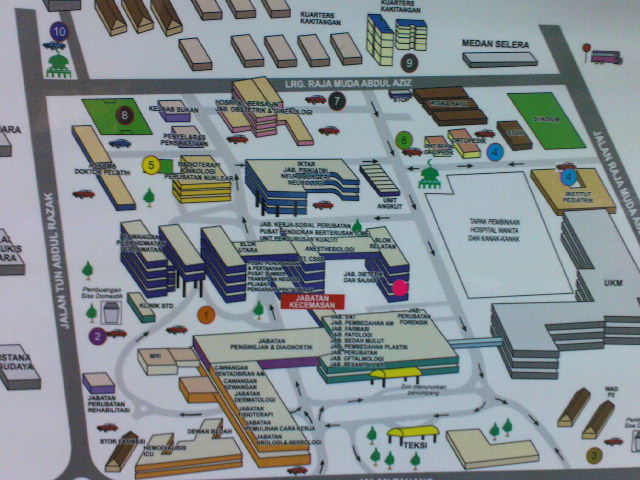
Pemandangan dr beranda deparment dermatology


Tour de HKL


akan bersambung...tgk pic pn ok

Friday, April 09, 2010

HKL - Dermatology Day Care


Dengan nama Allah yg Maha Pemurah lg Maha Penyayang
Selawat & salam ke atas Rasulullah Shalallahu alayhi wasalam,keluarga & para sahabatnya

"Hello,selamat pagi/petang..ini dermatology,bley sy bantu?"

Sedikit ulasan & catatan sepanjang sy berpraktikal di Dermatology Department
Musculoskeletal - Electrotherapy - Phototherapy

Conditions treated by Physiotherapist by ultraviolet radiation(UVR) :
1. Psoriasis
2. Vitiligo
3. Alopecia
4. Myocosis fungoides
5. Pityriasis rosea
6. Polymorphic light eruption
7. Acne vulgaris

Examination of patients with skin conditions....bla..bla..until record keeping (to be cont)

SUNLIGHT IS MADE OF :

2% - UVA ( 320 – 400 nm ) & UVB ( 290 - 320 nm )
32% - VISIBLE LIGHT( 400 – 760 nm )
66% - INFRA RED RAYS( HEAT )
0% - UVC ( 200 – 290 nm ) – IS FILTERED OFF BY THE OZONE LAYER

U L T R A V I O L E T R A Y S

These UVR are electromagnetic rays with a wavelength between 100-400nm. Conventionally they are divided into 3 bands:
1) Long : UVA : 320-400nm
2) Medium : UVB : 290-320nm
3) Short : UVC : 180-290nm
[ A B C = 400 320 290 180 ]

Simple notes...to be cont
~ skg da jarang guna UVC krn penetration dia hanya superficial shj
~ NB UVB better than BB UVB coz side effect kurang sikit & selalunya pt akan c/o itchiness & erythema....(NB UVB kt HKL rosak)
~ Oral PUVA : 2hrs before treatment
~ Topical PUVA : 15min after sapu meladinine
~ Utk psoriasis before nk enter kabin sapu liquid paraffin utk melembutkan kulit,elak kulit jd kering atau menyakitkan & memudahkn UV diserap
~ Photosensitizing drug : the drug makes the skin sensitive to UVA light
~ Medication : BVC, 8-MOP , 5-MOP , TMP.....
~ Utk patient psoriasis yg nk buat treatment UVB jgn sapu apa2 krim pada kulit
~ Dosage : 4-7dys,2wks,3wks,4wks,>4wks = hold,25,50,75,start over again
~ Risk of malignant melanoma : 1500J - 2000J
~ Photo patch test : ....

Thursday, April 08, 2010

Lukisan hati


Dengan nama Allah yg Maha Pemurah lg Maha Penyayang
Selawat & salam ke atas Rasulullah Shalallahu alayhi wasalam,keluarga & para sahabatnya

Rindu untuk menconteng & melakar lukisan hati ke dlm blog kesayanganku ini
Masa berlalu dgn pantas sangat,rasa seolah-olah nk pause aje masa tu...bley ke??
Dan terus terang mmg nini xreti nk manage masa...haiya manyak susah~~~hrmm
Suka melakukan lawatan sambil belajar dgn cik.internet merayau2..xbaguskan
Padahal byk kerja lain yg penting nk kena buat..ataupn nini menemani katil,Zzz~
Practical mmg memenatkan tp conoookk!!!

Nini nk berubah,tp kena slow2 kn..kn..kn..heee =P

Wednesday, April 07, 2010

Cayang meow


Dengan nama Allah yg Maha Pemurah lg Maha Penyayang
Selawat & salam ke atas Rasulullah Shalallahu alayhi wasalam,keluarga & para sahabatnya

Ya Allah...
Meow ini adlh makhluk ciptaanMU,kurniaan yg amat berharga buatku
Menceriakan & memeriahkan kehidupan kami sekeluarga
Saya menyayanginya sepenuh hati saya...jika dia luka,saya turut terluka
Tolong berikan kesejahteraan kpd hidupnya & kesembuhan kpdnya agar saya masih berpeluang utk memberikannya kebahagiaan secukupnya...Amiin Ya Rabbal 'Alamin

Thursday, March 11, 2010

WindOw shopping or...


Dengan nama Allah yg Maha Pemurah lg Maha Penyayang
Selawat & salam ke atas Rasulullah Shalallahu alayhi wasalam,keluarga & para sahabatnya

Kalau pesta buku mmg sukaaaaa sgt (^_^)V
Tapi adakah duit mencukupi???...hmmmm~~~~~
Xdpt beli,cuci mata pun cukup,hehe
Beznyee harap2 dpt menjejakkan kaki disana!
Dah lama xkeluar jln2,asyik2 uma,hostel,hospital
Bley dating ngn kakak skali kalau dia free =)

Monday, March 01, 2010

HKL part 1


Dengan nama Allah yg Maha Pemurah lg Maha Penyayang
Selawat & salam ke atas Rasulullah Shalallahu alayhi wasalam,keluarga & para sahabatnya

Pic : masa tgh bermalas-malasan,dgn hidayah kt physio lab kOt (kami berdua akan keluar sama2 mjadi seorg physiotherapist,insyaAllah ^_^)

Skg sebenarnya bukan masa yg sesuai nk ngada2 menulis kt blog ni tp disebabkn nk release semua dlm otak ni..byk perkara yg difikirkn & sebagai kenangan tuk nini baca time discharge dr HKL,hehehe,weeee~~~ insyaAllah sume ada,manis & pahit

Busy ngn clinical pun wat nini fikir byk perkara lain,contohnya mula2 tu sbb pisah ngn kwn2,pastu nini terlalu fikirkan clinical smpi jarang call mama tp alhamdulillah mama yg call nini,cayang mama!!!..kakak yg sanggup dtg hostel hantar mknn mama msk..pastu ekin & azi yg mengharukan nini sbb rajin ziarah nini kt bilik,kdg2 tu tgh nini nyenyak tido tp xpe nini sgt gembira mereka sanggup nk tgk2kn diri ini yg keseorg di bilik ='(...& hubungan nini ngn ehem2 ni =P mcm2 blaku,nini rasa teruk sgt sbb kcikkn hati dia..sgt2 xperasan,xsangka perkara yg sama berulang lg,sumenye gara2 perangaiku ini..kdg2 tu rindu sgt masa form4 sgt suci lg dr pergaulan dgn lelaki,seronok sbb byk masa dgn kwn2 usrah & beribadat..solat dhuha yg dulu kami selalu buat skg dah ditinggalkn,hmmm...masa yg lepas xle kembali lg.

Ok da mengarut,tp mmg nk spent time tuk tulis semua ni,pukul 11 nk stress benda lain pula..mmg HKL nini rasa tmpt paling tension,nk wat case presentation pastu asgmnt pastu nk stdy..assessmnt patient xsiap lg,penat xyah cite mmg penat...ckp pasal penat,nini kalau esok clinical mmg tido 2/3jam je,sbb kelam kabut nk siapkn sume perkara & bgun pukul4/5 pg sbb tuk breakfast,solat subuh & siap2 xle nk lama sgt sbb kalo lama sgt nanti kena tinggal bus mcm hari ni 01/03/10 nasib baik ada lg 1bus,mmg tu pun nini da cuba utk awal turun pukul6.30,berlari2 turun tangga kalo jatuh tu mmg padan muka sendiri..kalo bus full tpaksa la berdiri ='( balik clinical pun mcm tu,bdn siapa yg xpenat...disbbkn tu nini makin pemalas nk pergi kafe yg bagaikn jauh beribu batu,nk naik bilik yg tinggi tu lg..dah la kt hosp da penat berdiri..pernah hari 1 khamis 18hb balik bilik penat lps solat terus tidur ingat nk sekejap je last2 sampai pukul4pg!!..bangun mandi & stdy skit2..lps tu da xtdo da,hanya tido pukul 2pg so selamat dr terbabas tido...dah la setakat ni je..byk sgt tulis,smbung kt rumah time cuti mid sem

Cont utk bab melencong...& tour de HKL & bab nasi

Hari ni nk stdy care protocol & wat asgmt...selamat menderakn diri sendiri,skg nasi da xpenting =P

Sunday, February 07, 2010

Last minute


Dengan nama Allah yg Maha Pengasih & Maha Penyayang
Selawat & salam ke atas Rasulullah SAW,keluarga & para sahabatnya

"Dont study last minute but study till the last minute"

Thursday, February 04, 2010

Student life


Dengan nama Allah yg Maha Pengasih lagi Maha Penyayang
Selawat & salam ke atas Rasulullah S.A.W,keluarga & para sahabatnya

Picture sy ketika hendak pergi ke kafe hospital bersama 'geng' semasa waktu rehat(sepatutnya dah habis waktu kelas seperti biasa pukul 5pm)...kelas hari ini berlanjutan sehingga pukul7.30pm..petang itu hujan turun dgn indahnya,menyirami hati yg penat =P hadiah dr Allah mungkin (n_n)

Skin condition by Pn Nurul Liyana Leong
Physiotherapis Hospital Sg. Buloh

K.A.D.A.N.G.2...saya...
Kadang2 rasa penat/tension stdy
Kadang2 rasa seronok stdy
Kadang2 fikir kalau kahwin je kan senang ada suami jaga
Kadang2 fikir kerja berbakti pd masyarakat mjdkn hidup lbh bmakna
Kadang2 fikir jadi kanak2 lg best,sentiasa gembira..xperlu pergi sekolah
Kadang2 fikir belajar dlm bidang agama lg bagus sbb dpt ilmu utk dkt pdNYA

Erti semua kadang2
Penat & seronok buat hidup xboring
Wanita pun kena berilmu,xboleh bgantung pd suami shj,jika ditimpa musibah/diceraikan
Berbakti pd sesuatu perkara lebih baik dr meminta bakti
Menjadi kanak2 xdpt kenal/berfikir lbh dkt kebesaran Allah,asyik fikir seronok aje
Xsemestinya belajar agama baru dpt dktkn diri pd Allah,cuma bergantung pd diri seseorg itu samada mahu @ tidak shj...kelas agama kan byk

"I have never known a successful person to be a negative person, and I’ve never known a negative person to be highly successful. The difference between success and failure here is merely in their mindsets" - Heera Singh, Trainer & Motivator

"Big people have big dreams, and small people have small dreams. If you want to change who you are, begin by changing the size of your dream" - Robert T.Kiyosaki, The Business School For People Who Like Helping People.

Monday, February 01, 2010

Resource package CR siap!


Dengan nama Allah yg Maha Pengasih lagi Maha Penyayang
Selawat & salam ke atas Rasulullah S.A.W,keluarga & para sahabatnya

Alhamdulillah dah siap!...boleh hantar esok ^_^
Siap awal sikit,spatutnya hantar 2bln lg tp time posting mesti busy...
Skg bley stdy dgn tenterammmm....

Saturday, January 16, 2010

Kuliah Jumaat


Dengan nama Allah Yang Maha Pengasih lagi Maha Penyayang
Selawat & salam ke atas Rasulullah S.A.W,keluarga & para sahabatnya

Kuliah Jumaat dari pukul1.00-2.00ptg
Kelas start balik pukul2.45ptg

"Menyingkap keindahan ummul kitab" Ustazah Latifah

Sangat seronok & alhamdulillah x sleepy,he2 =P

Belajar tajwid & tafsir surah Al-Fatiha

Ummul kitab = ibu segala kitab/ketua semua kitab

*PJK = perut jalan ke depan...he2,ustazah2

Thursday, January 14, 2010

Neuroplasticity + neuro assessment


Dengan nama Allah yg Maha Pengasih & Maha Penyayang
Selawat & salam ke atas Rasulullah Sallallahu 'Allaihi Wassalam, keluarga & para sahabatnya

N.E.U.RO....the hardest subject for a physiotherapist
Neurology...musculoskeletal...woman health...peadiatric...geriatics...cardiorespiratory

Starting introduction about neuro by madam Malathi xberapa faham!!!...& sleepy =P
But today neuro with Dr.Mazlina bt Mazlan (rehabilitation department) teori class + neuro assessment/test with Madam Mala,practical class

*Recall back about anatomy of brain...sem1

Anatomy & physiology
CEREBRUM
CEREBBELLUM
FRONTAL LOBE
PARIETAL LOBE
TEMPORAL LOBE
OCCIPITAL LOBE
MOTOR CORTEX
CORTICOL MAP
MOTOR PATHWAYS

NEUROPLASTICITY
BRAIN INJURY
2type :
1)Spontaneous : penumbra
2)Neuroplasticity
BLOOD SUPPLY
- circle of willis

BRAIN RECOVERY
BRAIN LESION
- diachisis/ "shocked through out"

MOTOR RECOVERY
MUSCLE ADAPTATION & MOTOR LEARNING
TREATMENT

NEURO PRACTICAL CLASS WITH MADAM MALATHI
1)Clonus : dont touch at the palm
2)Cogwheel : bg,xbg,bg,xbg...
3)Clasp knife
4)Latpipe :"keras mcm besi"
5)Flacid

Nini,ekin,hidayah,nad,dila : berg balance scale (14step)

~hemineglect: sensory problem

~TO BE CONT~ too many!

Tuesday, January 12, 2010

USWD,arthro & FRC


Dengan nama Allah yg Maha Pengasih & Maha Penyayang
Selawat & salam ke atas Rasulullah S.A.W,keluarga & para sahabatnya

CR - Under-water sealed drainage (USWD)
MS - Arthroplasty
CR - Practical class,handling mechanical ventilator
CR - Functional residual capacity

CR - UNDER-WATER SEALED DRAINAGE/ CHEST TUBEDefinition: Closed system drainage by re-establishing normal negative pressure in the pleura space (out + = in -)
Indications: pneumothorax,heamothorax,traumatic arrest (kaitan dgn lung contusion),empyema...others: ribs #,profound hypoxia/hypotension
Functions:to remove air/fluid from pleura cavity,re-expansion of the underlying lung& prevent entry of air/drained fluid back into the chest
3components:1)an unobstructed chest drain. 2)a collecting container chest level. 3)a one-way mechanism such as water seal
Principal:swing(must swing),bubbling(no bubbling)
Criteria for removal of intercostal catheter
Care of UWSD
Complications
Points to remember
Sign &s symptoms
Physiotherapist roles
Physiotherapist management

MS - ARTHROPLASTY
Overall
Knee replacement
Hip replacement/ hemiathroplasty

CR- FUNCTIONAL RESIDUAL CAPACITY

Thursday, January 07, 2010

3hari MS


Dengan nama Allah yg Maha Pengasih & Maha Penyayang
Selawat & salam ke atas Rasulullah S.A.W,keluarga & para sahabatnya

3hari berturut2 bljr ms dgn madam Kuna,physiotherapist dr Hospital Slim River...lecturer yg best & penuh ilmu physio didada...xlokek dgn ilmunya,tgk dr luaran hanya biasa shj tp jasanya amat byk utk patient2nya yg tlh dirawatnya.

1. Osteoarthritis
2. Haemophilic arthritis
3. Rheumatoid arthritis
4. Spondylosis
5. Spondylolothesis
6. Prolapsed Intervetebral Disk (DIP)
7. Whiplash injury
8. Torticollis
9. Osteomyelitis

The thing that need to remember : definition,type,pathology,etiology,clinical features,examination,aims of physio treatment,physio treatment.

Advice or extra from her:
* sit with ur leg uncrossed : bcoz this position may cause sclerosis,not good for ur spine
* must sometimes do a spot check for patient,to make sure patient follow our instruction..especially young or old people...they can cheating at u
* what is the normal clotting time???..don't know the answer yet =P
* tubigrip-thing like bandage
* one appo came to physio,with poor posture but complaint no pain...in examination,very bad xray of her spine...physio impression:OA..physio Rx: posture correction...can be no pain bcoz their already adapted to the condition,the appo mybe very hardworking lady for a long time ago
* always check sign of cancer or tumor, and ferer back to dr...dr can do a mistake on their diagnosis..so this can protect ourselves from do a wrong treatment to the patient...very dangerous bcoz this can may cause kematian
* patient collapse after doing traction...d/t eneurysm,cant blame sesiapa...


- acute lumbago??
- scoliosis exs
- boring pain??

~ pathology of OA
~ pathology of OM
~ exlpain torticollis
~ heamophilia
YX(HEMO)+ XX
YX + YX(CARRIER)
YX (HEMO) + XX (CARRIER)
YX + XX (HEMO)
~ 5 type of spondylosis

# appo : nenek
# ayi : mak cik
# apek : pak cik
# ah kong : atuk

Wednesday, January 06, 2010

New+Old=complicated


Dengan nama Allah yg Maha Pengasih & Maha Penyayang
Selawat & salam ke atas Rasulullah S.A.W,keluarga & para sahabatnya

Otak tepu = complication from new topic + old topic

Moral of the story = recall always & do revisions,be prepared aspecially for HKL!!!

05/01/10
Cardiorespiratory III
Introduction to intensive care unit (ICU)

*recall CRII
1)Chest physiotherapy,manual physiotherapy technique (postOP.preOP)
-BC,TEE,TEE&progression,resisted breathing exs,ACBT,localize breathing,huffing& coughing with wound support,TME,bed mobility,ambulation,postural awareness,adjuct~~

BLA..BLA..bla

Neuro (new topic for this sem,the most kenchang!!!)
to many assessment form + assignment to do during clinical


06/01/10
Neuro...cont GAIT
Madam Liza = headache Madam Mala = ok but sleepy

NORMAL GAIT + ABNORMAL GAIT

*recall GAIT
1)Gait cycle
-2phase : stance phase & swing phase
-1cycle consist of : 2initial contact for the same foot
-when double stance?? preswing during toe off,heel strike
-when single stance??
-what the thing that we must observe??? : time interval(...) + step length + stride length + width + quality of movement + ....

Scissor gait
Scissor gait is a form of gait abnormality primarily associated with spastic cerebral palsy. It is associated with an upper motor neuron lesion.
This gait pattern is reminiscent of a marionette. Hypertonia in the legs, hips and pelvis means these areas become flexed, to various degrees, giving the appearance of crouching, while tight adductors produce extreme adduction, presented by knees and thighs hitting or crossing in a scissors-like movement, while the opposing muscles, the abductors, become comparatively weak from lack of use. Most common in patients with spastic cerebral palsy, usually diplegic and paraplegic varieties. The individual is forced to walk on tiptoe unless the plantarflexor muscles are released by an orthaepedic surgical procedure.
These features are typical, and usually result in some form and to some degree regardless of the mildness or severity of the spastic CP condition.
-rigidity and excessive adduction of the leg in swing
-plantar flexion of the ankle
-flexion at the knee
-adduction and internal rotation at the hip
-progressive contractures of all spastic muscles
-complicated assisting movements of the upper limbs when walking
When not severe enough to interfere significantly with movement, function, longevity, energy levels or comfort, the scissor gait may be considered to be little more than a different walking "style".

Antalgic gait
Antalgic gait is a form of gait abnormality.
In it, the individual favors certain motions to avoid acute pain. [1]
Conditions associated with an antalgic gait
•Trauma
•Osteoarthritis
•Pelvic girdle pain
•Coxalgia
•tarsal tunnel syndrome

Cerebellar ataxia
Cerebellar ataxia is a form of ataxia originating in the cerebellum.
Romberg's test can be used to distinguish cerebellar ataxia from other forms of ataxia.

Festinating gait
Festinating gait (or Parkinsonian gait) is a form of gait abnormality.
Presentation : The patient moves with short, jerky steps. Term derives from Latin "festino", or "to hurry". The patient has difficulty starting, but also has difficulty stopping after starting. This is due to muscle hypertonicity.
Associated conditions with Parkinson's disease

Pigeon gait
Pigeon gait is a form of gait abnormality.
Presentation : Torsional abnormalities. (Hip dysplasia)

Propulsive gait
Propulsive gait is a form of gait abnormality.
Presentation : Stiff, with head and neck bent.
Conditions associated with a propulsive gait
-Carbon monoxide poisoning
-Parkinson's disease[2]
-Manganese Toxicity

Steppage gait
Steppage gait (High stepping, Neuropathic gait) is a form of gait abnormality. It is associated with a loss of dorsiflexion. It can be caused by damage to the peroneal nerve.
Presentation: Toes point down.
Conditions associated with a steppage gait
-Polio
-Multiple sclerosis
-Guillain-Barré
-Spinal disc herniation
-Peroneal Muscle Atropy
-Peroneal nerve Injury

Stomping gait
Stomping gait (or sensory ataxia gait) is a form of gait abnormality.
Presentation: Uncoordinated walking
Conditions associated with a stomping gait
-Friedreich's ataxia
-Pernicious anemia
-Tabes dorsalis
-Peripheral neuropathy
-Spinal cord disease
-Multiple sclerosis

Spastic gait
Spastic gait is a form of gait abnormality.
Among the treatment options is chemodenervation.[1]
Presentation
Asymmetric foot dragging.
Conditions associated with a spastic gait
-Brain tumor
-Brain abscess
-Sturge-Weber syndrome
-Cerebral palsy
-Cerebrovascular accident
-Multiple sclerosis

Myopathic gait
Myopathic gait (or waddling gait) is a form of gait abnormality.
The "waddling" is due to the weakness of the proximal muscles of the pelvic girdle. The patient uses circumduction to compensate for gluteal weakness.Conditions associated with a myopathic gait
-Pregnancy
-Congenital hip dysplasia
-Muscular dystrophy
-Spinal muscle atrophy

Magnetic gait
Magnetic gait is a form of gait abnormality.
Presentation: Feet seem attached to floor as if by a magnet. In magnetic gait, each step is initiated in a "wresting" motion carrying feet upward and forward. Magnetic gait can be visualized in terms of a powerful magnet being forcefully pulled from a steel plate.
Associated conditions
-Normal pressure hydrocephalus (NPH)

Trendelenburg gait
The Trendelenburg gait is an abnormal gait caused by weakness of the abductor muscles of the lower limb, gluteus medius and gluteus minimus. People with a lesion of superior gluteal nerve have weakness of abducting the thigh at the hip. This type of gait may also be seen in L5 radiculopathy and after poliomyelitis, but is then usually seen in combination with foot drop.
During the stance phase, the weakened abductor muscles allow the pelvis to tilt down on the opposite side. To compensate, the trunk lurches to the weakened side to attempt to maintain a level pelvis throughout the gait cycle. The pelvis sags on the opposite side of the lesioned superior gluteal nerve.

Crouch gait????...not sure,tricep with quad???..better ask madam Liza=P
Crouch gait, a gait pattern characterized by excessive knee flexion in terminal swing and stance, is a frequently observed gait deviation among children with diplegia. No unambiguous definition of crouch gait is present in the literature (Perry, 1992).
Increased knee flexion and ankle hyperdorsiflexion occur during stance phase. They occur in older children and after isolated triceps lengthenings that have been performed without addressing the spastic hamstrings. Hip flexors and hamstrings are tight, and quadriceps and triceps are weak (Gage & Novacheck, 2001).

Physiotherapy intervention
1)gait training
2)strength training
3)stretching
4)eliciting of muscle contraction
5)maximazing skill
bla...bla..bla...

ASSIGNMENT!!!!

Lastly = very stress + tired + lapar + miss my F.A.M.I.L.I.A. + miss pondok hatiku + miss my meow tomei2 + rest?? + sleep?? Zzz + study!!! + sick + .....

DREAM IT & ACHIEVE IT

Tuesday, January 05, 2010

Confirm HKL!!!


Dengan nama Allah yg Maha Pengasih & Maha Penyayang
Selawat & salam ke atas Rasulullah S.A.W,keluarga & para sahabatnya

True Clinical & my first clinical attachment = Hospital Kuala Lumpur

C.O.N.F.I.R.M...18/2/10-31/4/10...HKL...SEM4


sedih + takut + xnk pergi + ada hikmah + think positive + tabah + redha

5 weeks for cr, 5 weeks for ms

Saturday, December 26, 2009

Physiotherapist


Dengan nama Allah yg Maha Pengasih dan Maha Penyayang
Selawat & salam ke atas Rasulullah S.A.W,keluarga & para sahabatnya

Firstly,for information "aku sebesar impianku" mostly will be in english..u know why,of course due to my course physiotherapy is learning in english (tp yg menulis ni xberapa expert in english,english selalu dpt B je..but i will try my best to improve my english)...if too susah akan dirojakkan with bahasa melayu,bolehkan.. http://emo.huhiho.com english broken xkesah asalkan sy faham

Still in learning process to be a physiotherapist, not qualified yet..hopefully insyaAllah 2011http://emo.huhiho.com

Physiotherapy is a clinical health science and profession that aims to rehabilitate and improve people with movement disorders by
- using evidence-based,
- natural methods such as exercise,
- motivation,
- adapted equipment,
- education.

The physiotherapist works in health care systems in both hospitals and the community. Physiotherapist are experts in the examination and treatment of musculoskeletal, neuromuscular and cardiothoracic problems that affect peoples’ abilities to move the way they want and function as well as they want in their daily lives

Physiotherapy in MALAYSIA ?????
Started it first physiotherapy services in 1950.
Located at the major Hospital, e.g. Taiping, Pulau Pinang, Sg Buluh.
Most of the physiotherapist were foreigeiners

MALAYSIA PHYSIOTHERAPY ASSOCIATION

Vision
The physiotherapy profession is committed to provide excellent rehabilitative service that is easily accessible to all in the community.The profession strived to continuously improves and acquires the latest knowledge,skills and technologies to ensure its patient's best recovery and enjoy enchanced quality of life.
Mission

Aims
1)To represent physiotherapist of this country.
2)To guide and promote the development of the profession by advocating high standards of practice.
3)To promote ethical practice and accountable professional service
4)To protect the professional names of Physical Therapy or Physiotherapy and the titles Physical Therapist or Physiotherapist as such or in any translation, are the sole preserve of members who hold qualifications approved by the Association  that are members of the World Confederation for Physical Therapy (WCPT).
5)To maintain an up-to-date register of persons qualified to practice and teach physiotherapy
6)To efficiently and effectively manage the Association's funds
7)To organize conferences, public meetings and lectures to enhance professional development.
8)To circulate publications such as the Executive Committee deems necessary or desirable pertaining to the development of the profession.
9)To contribute and support fund raising projects, following the guidelines approved by the Association to promote the development of physiotherapy.
10)To conduct health promotion programmes pertaining to the current needs of the community.

Musculoskeletal (Orthopaedic) physiotherapists
- are able to diagnose, treat and using the range of techniques outlined below help with prevention of pain/pathology.
-Various therapeutic physical therapy modalities are available, including
1. Exercise prescription
2. Manual therapy techniques
3. Various forms of so-called “electrophysical agents”.Despite ongoing research giving a clearer picture regarding the use of various modalities in specific conditions, the benefits of electrotherapy are widely debated.

Cardiopulmonary physical therapy
-They treat acute problems like
1.asthma, acute chest infections and
2.trauma
3.involved in the preparation and recovery of patients from major surgery
4.also treat a wide range of chronic cardiac and respiratory conditions like Chronic Obstructive Pulmonary Disease and post-myocardial infarction
-Work with all ages from premature babies to older adults at the end of their life.
-Physical therapists are pioneering new management techniques for non-organic respiratory problems like hyperventilation and other stress-related disorders as well as leading the development of cardio-pulmonary rehabilitation and non-invasive ventilation.

Neurological physical therapy
-Treatment in neurological conditions is typically based upon exercises to restore motor function through attempting to overcome motor deficits and improve motor patterns

Integumentary physical therapy
-Treatment of conditions involving the skin and related organs. Common conditions include wounds and burns. Treatment interventions include debridement of wounds and burns, dressings, scar prevention and reduction

Showing posts with label aku sebesar impianku. Show all posts

Friday, September 03, 2010

Chest X-Ray

Chest x rays made easy

The aim of this five part series is to give you a basic system for looking at chest x ray films. They should enable you to say something sensible when presented with a film in your finals and be confident that you are not missing serious disease when you view a film on your own as a house officer.

Looking at chest x ray films - the system By the time you do finals you will have learnt a system for examining the abdomen; you also need to develop a system for looking at x ray films. This will reduce your chances of missing abnormalities and it will provide a structured patter to come out with in exams when you are under pressure.

Let's start by looking at a normal chest x ray film (fig 1). Use this film as a reference point during the rest of the article. Firstly, some technical details: Quickly look at the film to get some useful information about the patient:


Fig 1 Normal chest x ray film

  • Male or female? Look for the presence of breast shadows (this will help you to notice a mastectomy too).
  • Old or young? Try to use the patient's age to your advantage by making sensible suggestions. A 20 year old is much less likely to have malignancy than someone who is 70.
  • Good inspiration? It's easy to get tied up in knots over this - and sometimes not get any further. The diaphragms should lie at the level of the sixth ribs anteriorly. The right hemidiaphragm is usually higher than the left because the liver pushes it up.
  • Good penetration? You should just be able to see the lower thoracic vertebral bodies through the heart.
  • Is the patient rotated? The spinous processes of the thoracic vertebrae should be midway between the medial ends of the clavicles.
  • Most chest x ray films are taken posterior anterior (PA) - that is, the x rays shoot through from the back of the patient to the x ray plate in front of the patient. If the patient is too sick to stand up for this, an anterior posterior (AP) film will be done - that is, the x rays shoot through from front to back. An anterior posterior film will always be labelled as AP, so if nothing is written on the film it is safe to assume it is PA. PA films are better, particularly because the heart is not as magnified as on an AP film, making it easier to comment on the heart size. Tip: You can avoid the whole PA/AP debate by describing all chest x ray films "frontal" - that is, you are looking at the patient straight on.
  • Finally, some examiners like you to call x ray films radiographs; strictly speaking you can't actually see the x rays themselves.

You can summarise all the above information in a simple opening phrase: "This is a frontal chest radiograph of a young male patient. The patient has taken a good inspiration and is not rotated; the film is well penetrated."

While you are saying this keep looking at the film.

  • First look at the mediastinal contours - run your eye down the left side of the patient and then up the right.
  • The trachea should be central. The aortic arch is the first structure on the left, followed by the left pulmonary artery; notice how you can trace the pulmonary artery branches fanning out through the lung (see fig 1).
  • Two thirds of the heart lies on the left side of the chest, with one third on the right. The heart should take up no more than half of the thoracic cavity. The left border of the heart is made up by the left atrium and left ventricle.
  • The right border is made up by the right atrium alone (the right ventricle sits anteriorly and therefore does not have a border on the PA chest x ray film - a question that examiners love to ask. Above the right heart border lies the edge of the superior vena cava.
  • The pulmonary arteries and main bronchi arise at the left and right hila. Enlarged lymph nodes can also occur here, as can primary tumours. These make the hilum seem bulky - note the normal size of the hila on this film.
  • Now look at the lungs. Apart from the pulmonary vessels (arteries and veins), they should be black (because they are full of air). Scan both lungs, starting at the apices and working down, comparing left with right at the same level, just as you would when listening to the chest with your stethoscope. The lungs extend behind the heart, so look here too. Force your eye to look at the periphery of the lungs - you should not see many lung markings here; if you do then there may be disease of the air spaces or interstitium. Don't forget to look for a pneumothorax - in which case you would see the sharp line of the edge of the lung.
  • Make sure you can see the surface of the hemidiaphragms curving downwards, and that the costophrenic and cardiophrenic angles are not blunted - suggesting an effusion. Check there is no free air under the hemidiaphragm.
  • Finally look at the soft tissues and bones. Are both breast shadows present? Is there a rib fracture? This would make you look even harder for a pneumothorax. Are the bones destroyed or sclerotic? (see fig 2)


Fig 2 Sclerotic-white metastasis in the right seventh rib

You can summarise your findings as you are looking: "The trachea is central, the mediastinum is not displaced. The mediastinal contours and hila seem normal. The lungs seem clear, with no pneumothorax. There is no free air under the diaphragm. The bones and soft tissues seem normal."

If you have not seen any abnormality by this point, say so - "I have not yet identified an abnormality so I will now look through my review areas" - and then look at the "review areas" - places where you can easily miss disease. These are: apices, periphery of the lungs, under and behind the hemidiaphragms (don't forget the lungs will extend here), and behind the heart. By the time you have gone through the above, showing that you are looking at the film in a logical fashion, the examiner should guide you towards the abnormality.

You may be shown a lateral chest x ray (see fig 3), usually to confirm a diagnosis you have made on the PA film. Therefore don't panic when the lateral goes up because it means you've probably made the diagnosis. There are only two spaces to look at on the later- al film.


Fig 3 Lateral chest x ray (normal)

The heart lies antero-inferiorly. Look at the area anterior and superior to the heart. This should be black, because it contains aerated lung. Similarly the area posterior to the heart should be black right down to the hemidiaphragms. The blackness in these two areas should be equivalent; therefore you can compare one with the other. If the area anterior and superior to the heart is opacified, suspect disease in the anterior mediastinum or upper lobes. If the area posterior to the heart is opacified suspect collapse or consolidation in the lower lobes.

*http://archive.student.bmj.com/issues/00/09/education/316.php

*Cardiorespiratory

Thursday, August 26, 2010

Paraplegia

Bismillahirrahmanirrahim
Dengan nama Allah yg Maha Pengasih lg Maha Penyayang
Selawat & salam ke atas junjungan besar Nabi Muhammad SAW,keluarga & para sahabat baginda

Assalamu'alaikum
Alhamdulillah saya bersyukur kerana dpt peluang utk belajar & merawat patient Spinal Cord Injury bagi subject neurology...dan selesai membentangkan case presentation.Sy begitu terhutang budi & ilmu dr En.Zaidey kerana byk membantu sy disepanjang minggu sy dibertugas dibwh rehab...skema kn ayat2 sy ni..hehehe

:minimo_06:Ini adalah keadaan sy yg serabut before case presentation...dup dap dup dap...
:minimo_05:Ini pula after case presentation..tapi ada juga soalan2 yg xdpt dijwb..huhuhuhu..

biasalah soalan anatomy..tiba2 ditanya tntg diaphragm..ish3,ada ke patut..tanyalah tntg spinal cord ke kan...

*Moral of this story..anatomy mesti power!

Friday, July 02, 2010

Nak kena study


Bismillahirrahmanirrahim
Dengan nama Allah yg Maha Pengasih lg Maha Penyayang
Segalanya dimulakan dgn menyebut nama yg Maha Esa
Selawat dan salam ke atas junjungan besar Nabi Muhammad SAW,keluarga dan para sahabat baginda

Hari ni hari pertama kelas bg utk tahun 3 sem 1,sebenarnya lebih kpd taklimat utk sem ni...kls mmg padat,dr hari isnin hingga hari sabtu dan kemungkinan hari ahad juga..ya Allah semoga ku berjaya mengharunginya

Subject for this sem..total = 4
1. Woman Health
2. Paediatrics
3. Geriatics
4. Neurology

Otak masih beku,nk kena tunggu di cair kan supaya mudah ilmu2 utk mengalir kembali dan mudah diserap kembali...

Dalam kesibukan utk mencairkan otak ni,saya mahu iman saya turut terjaga..

Rasulullah SAW bersabda yang bermaksud: "Iman yang paling afdal ialah apabila kamu mengetahui bahawa Allah selalu menyertaimu di mana pun kamu berada." (Hadis riwayat Ath Tabrani)

Nak stdy psl cerebral ataxia...buka aje buku,baca skit je..

*Sgt xde mood nk stdy...cuba lg esok*

Monday, April 19, 2010

Ujian merupakan kebaikan


Dengan nama Allah yg Maha Pemurah lg Maha Penyayang
Selawat & salam ke atas Rasulullah Shalallahu alayhi wasalam,keluarga & para sahabatnya

Jam sentiasa akan berdetik setiap masa,jarum masa x akan jemu untuk berpusing...akhirnya kembali bertemu dengan peperiksaan!!!

Ya,sudah semestinya hati akan mula cemas..dup..dap..dup...dap..ya Allah takutnya!!!
Adakah diri ini sudah bersedia???..pesan mama & papa "kena selalu bersedia so xakan rasa takut bila nak exam"...masalahnya kan,hihihi..sy suka mencari alasan,insyaAllah pesan mama & papa nini akan ingat...ingat je???..ok,ok nini cuba buat =P


Bila di renungkan...sebenarnya hidup kita ini adalah sebuah ujian,mesti pernah dengarkan?...contohnya : Islam adalah ad-deen iaitu cara hidup sebagai hambaNYA so bila kita menunaikan/melanggar kewajipan sebagai seorang muslim akan dicatat oleh malaikat yg setia disamping kita x akan jemu mencatat markah buat kita,samada markah akan di tambah atau ditolak...akhirnya akan disemak dihari pembalasan kelak

Bila mengalami kegagalan
- Mula2 mesti sedih,sedih & sedih tapi adakah mahu sedih selamanya?..mesti masih ada peluang untuk memperbaiki kegagalan tu...hanya perlu = tidak akan berputus asa,perlu bangkit semula
- Pencipta ujian/pemeriksa ujian peperiksaan di dunia ini adalah merupakan seorang guru,mereka x akan rugi jika anak muridnya gagal..betulkan?..begitu juga dengan Yang Maha Pencipta Sekalian Alam,bahkan DIA mencipta ujian bukan untuk membinasakan hambaNYA tapi sebagai kebaikan buat hambaNYA

Allah Maha Pengampun lagi Maha Penyayang
" hai org-org beriman, bertaqwalah kamu kpd Allah dan katakanlah perkataan yg benar, niscaya Allah perbaiki bagimu amalan-amalanmu & mengampuni bagimu dosa-dosamu. Dan barang siapa yg mentaati Allah & rasulNYA, maka sesungguhnya ia telah mendapat kemenangan yg besar " Al-Ahzab : 70-71

Apabila peluang untuk menduduki kembali ujian sudah di tutup
" pada hari ketika muka mereka dibolak balikkan dalam neraka, mereka berkata, "alangkah baiknya andai kata kami taat kpd Allah & juga taat kpd rasul " Al-Ahzab : 66

Sebaris ayat sebagai peringatan untuk hatiku dan yg membacanya
" keseronokkan di dunia hanyalah sekejap nikmatnya,balasan di akhirat adalah selama-lamanya "

Saturday, April 10, 2010

HKL part luahan perasaan


Pemandangan dr beranda deparment dermatology


Tour de HKL


akan bersambung...tgk pic pn ok

Friday, April 09, 2010

HKL - Dermatology Day Care


Dengan nama Allah yg Maha Pemurah lg Maha Penyayang
Selawat & salam ke atas Rasulullah Shalallahu alayhi wasalam,keluarga & para sahabatnya

"Hello,selamat pagi/petang..ini dermatology,bley sy bantu?"

Sedikit ulasan & catatan sepanjang sy berpraktikal di Dermatology Department
Musculoskeletal - Electrotherapy - Phototherapy

Conditions treated by Physiotherapist by ultraviolet radiation(UVR) :
1. Psoriasis
2. Vitiligo
3. Alopecia
4. Myocosis fungoides
5. Pityriasis rosea
6. Polymorphic light eruption
7. Acne vulgaris

Examination of patients with skin conditions....bla..bla..until record keeping (to be cont)

SUNLIGHT IS MADE OF :

2% - UVA ( 320 – 400 nm ) & UVB ( 290 - 320 nm )
32% - VISIBLE LIGHT( 400 – 760 nm )
66% - INFRA RED RAYS( HEAT )
0% - UVC ( 200 – 290 nm ) – IS FILTERED OFF BY THE OZONE LAYER

U L T R A V I O L E T R A Y S

These UVR are electromagnetic rays with a wavelength between 100-400nm. Conventionally they are divided into 3 bands:
1) Long : UVA : 320-400nm
2) Medium : UVB : 290-320nm
3) Short : UVC : 180-290nm
[ A B C = 400 320 290 180 ]

Simple notes...to be cont
~ skg da jarang guna UVC krn penetration dia hanya superficial shj
~ NB UVB better than BB UVB coz side effect kurang sikit & selalunya pt akan c/o itchiness & erythema....(NB UVB kt HKL rosak)
~ Oral PUVA : 2hrs before treatment
~ Topical PUVA : 15min after sapu meladinine
~ Utk psoriasis before nk enter kabin sapu liquid paraffin utk melembutkan kulit,elak kulit jd kering atau menyakitkan & memudahkn UV diserap
~ Photosensitizing drug : the drug makes the skin sensitive to UVA light
~ Medication : BVC, 8-MOP , 5-MOP , TMP.....
~ Utk patient psoriasis yg nk buat treatment UVB jgn sapu apa2 krim pada kulit
~ Dosage : 4-7dys,2wks,3wks,4wks,>4wks = hold,25,50,75,start over again
~ Risk of malignant melanoma : 1500J - 2000J
~ Photo patch test : ....

Thursday, April 08, 2010

Lukisan hati


Dengan nama Allah yg Maha Pemurah lg Maha Penyayang
Selawat & salam ke atas Rasulullah Shalallahu alayhi wasalam,keluarga & para sahabatnya

Rindu untuk menconteng & melakar lukisan hati ke dlm blog kesayanganku ini
Masa berlalu dgn pantas sangat,rasa seolah-olah nk pause aje masa tu...bley ke??
Dan terus terang mmg nini xreti nk manage masa...haiya manyak susah~~~hrmm
Suka melakukan lawatan sambil belajar dgn cik.internet merayau2..xbaguskan
Padahal byk kerja lain yg penting nk kena buat..ataupn nini menemani katil,Zzz~
Practical mmg memenatkan tp conoookk!!!

Nini nk berubah,tp kena slow2 kn..kn..kn..heee =P

Wednesday, April 07, 2010

Cayang meow


Dengan nama Allah yg Maha Pemurah lg Maha Penyayang
Selawat & salam ke atas Rasulullah Shalallahu alayhi wasalam,keluarga & para sahabatnya

Ya Allah...
Meow ini adlh makhluk ciptaanMU,kurniaan yg amat berharga buatku
Menceriakan & memeriahkan kehidupan kami sekeluarga
Saya menyayanginya sepenuh hati saya...jika dia luka,saya turut terluka
Tolong berikan kesejahteraan kpd hidupnya & kesembuhan kpdnya agar saya masih berpeluang utk memberikannya kebahagiaan secukupnya...Amiin Ya Rabbal 'Alamin

Thursday, March 11, 2010

WindOw shopping or...


Dengan nama Allah yg Maha Pemurah lg Maha Penyayang
Selawat & salam ke atas Rasulullah Shalallahu alayhi wasalam,keluarga & para sahabatnya

Kalau pesta buku mmg sukaaaaa sgt (^_^)V
Tapi adakah duit mencukupi???...hmmmm~~~~~
Xdpt beli,cuci mata pun cukup,hehe
Beznyee harap2 dpt menjejakkan kaki disana!
Dah lama xkeluar jln2,asyik2 uma,hostel,hospital
Bley dating ngn kakak skali kalau dia free =)

Monday, March 01, 2010

HKL part 1


Dengan nama Allah yg Maha Pemurah lg Maha Penyayang
Selawat & salam ke atas Rasulullah Shalallahu alayhi wasalam,keluarga & para sahabatnya

Pic : masa tgh bermalas-malasan,dgn hidayah kt physio lab kOt (kami berdua akan keluar sama2 mjadi seorg physiotherapist,insyaAllah ^_^)

Skg sebenarnya bukan masa yg sesuai nk ngada2 menulis kt blog ni tp disebabkn nk release semua dlm otak ni..byk perkara yg difikirkn & sebagai kenangan tuk nini baca time discharge dr HKL,hehehe,weeee~~~ insyaAllah sume ada,manis & pahit

Busy ngn clinical pun wat nini fikir byk perkara lain,contohnya mula2 tu sbb pisah ngn kwn2,pastu nini terlalu fikirkan clinical smpi jarang call mama tp alhamdulillah mama yg call nini,cayang mama!!!..kakak yg sanggup dtg hostel hantar mknn mama msk..pastu ekin & azi yg mengharukan nini sbb rajin ziarah nini kt bilik,kdg2 tu tgh nini nyenyak tido tp xpe nini sgt gembira mereka sanggup nk tgk2kn diri ini yg keseorg di bilik ='(...& hubungan nini ngn ehem2 ni =P mcm2 blaku,nini rasa teruk sgt sbb kcikkn hati dia..sgt2 xperasan,xsangka perkara yg sama berulang lg,sumenye gara2 perangaiku ini..kdg2 tu rindu sgt masa form4 sgt suci lg dr pergaulan dgn lelaki,seronok sbb byk masa dgn kwn2 usrah & beribadat..solat dhuha yg dulu kami selalu buat skg dah ditinggalkn,hmmm...masa yg lepas xle kembali lg.

Ok da mengarut,tp mmg nk spent time tuk tulis semua ni,pukul 11 nk stress benda lain pula..mmg HKL nini rasa tmpt paling tension,nk wat case presentation pastu asgmnt pastu nk stdy..assessmnt patient xsiap lg,penat xyah cite mmg penat...ckp pasal penat,nini kalau esok clinical mmg tido 2/3jam je,sbb kelam kabut nk siapkn sume perkara & bgun pukul4/5 pg sbb tuk breakfast,solat subuh & siap2 xle nk lama sgt sbb kalo lama sgt nanti kena tinggal bus mcm hari ni 01/03/10 nasib baik ada lg 1bus,mmg tu pun nini da cuba utk awal turun pukul6.30,berlari2 turun tangga kalo jatuh tu mmg padan muka sendiri..kalo bus full tpaksa la berdiri ='( balik clinical pun mcm tu,bdn siapa yg xpenat...disbbkn tu nini makin pemalas nk pergi kafe yg bagaikn jauh beribu batu,nk naik bilik yg tinggi tu lg..dah la kt hosp da penat berdiri..pernah hari 1 khamis 18hb balik bilik penat lps solat terus tidur ingat nk sekejap je last2 sampai pukul4pg!!..bangun mandi & stdy skit2..lps tu da xtdo da,hanya tido pukul 2pg so selamat dr terbabas tido...dah la setakat ni je..byk sgt tulis,smbung kt rumah time cuti mid sem

Cont utk bab melencong...& tour de HKL & bab nasi

Hari ni nk stdy care protocol & wat asgmt...selamat menderakn diri sendiri,skg nasi da xpenting =P

Sunday, February 07, 2010

Last minute


Dengan nama Allah yg Maha Pengasih & Maha Penyayang
Selawat & salam ke atas Rasulullah SAW,keluarga & para sahabatnya

"Dont study last minute but study till the last minute"

Thursday, February 04, 2010

Student life


Dengan nama Allah yg Maha Pengasih lagi Maha Penyayang
Selawat & salam ke atas Rasulullah S.A.W,keluarga & para sahabatnya

Picture sy ketika hendak pergi ke kafe hospital bersama 'geng' semasa waktu rehat(sepatutnya dah habis waktu kelas seperti biasa pukul 5pm)...kelas hari ini berlanjutan sehingga pukul7.30pm..petang itu hujan turun dgn indahnya,menyirami hati yg penat =P hadiah dr Allah mungkin (n_n)

Skin condition by Pn Nurul Liyana Leong
Physiotherapis Hospital Sg. Buloh

K.A.D.A.N.G.2...saya...
Kadang2 rasa penat/tension stdy
Kadang2 rasa seronok stdy
Kadang2 fikir kalau kahwin je kan senang ada suami jaga
Kadang2 fikir kerja berbakti pd masyarakat mjdkn hidup lbh bmakna
Kadang2 fikir jadi kanak2 lg best,sentiasa gembira..xperlu pergi sekolah
Kadang2 fikir belajar dlm bidang agama lg bagus sbb dpt ilmu utk dkt pdNYA

Erti semua kadang2
Penat & seronok buat hidup xboring
Wanita pun kena berilmu,xboleh bgantung pd suami shj,jika ditimpa musibah/diceraikan
Berbakti pd sesuatu perkara lebih baik dr meminta bakti
Menjadi kanak2 xdpt kenal/berfikir lbh dkt kebesaran Allah,asyik fikir seronok aje
Xsemestinya belajar agama baru dpt dktkn diri pd Allah,cuma bergantung pd diri seseorg itu samada mahu @ tidak shj...kelas agama kan byk

"I have never known a successful person to be a negative person, and I’ve never known a negative person to be highly successful. The difference between success and failure here is merely in their mindsets" - Heera Singh, Trainer & Motivator

"Big people have big dreams, and small people have small dreams. If you want to change who you are, begin by changing the size of your dream" - Robert T.Kiyosaki, The Business School For People Who Like Helping People.

Monday, February 01, 2010

Resource package CR siap!


Dengan nama Allah yg Maha Pengasih lagi Maha Penyayang
Selawat & salam ke atas Rasulullah S.A.W,keluarga & para sahabatnya

Alhamdulillah dah siap!...boleh hantar esok ^_^
Siap awal sikit,spatutnya hantar 2bln lg tp time posting mesti busy...
Skg bley stdy dgn tenterammmm....

Saturday, January 16, 2010

Kuliah Jumaat


Dengan nama Allah Yang Maha Pengasih lagi Maha Penyayang
Selawat & salam ke atas Rasulullah S.A.W,keluarga & para sahabatnya

Kuliah Jumaat dari pukul1.00-2.00ptg
Kelas start balik pukul2.45ptg

"Menyingkap keindahan ummul kitab" Ustazah Latifah

Sangat seronok & alhamdulillah x sleepy,he2 =P

Belajar tajwid & tafsir surah Al-Fatiha

Ummul kitab = ibu segala kitab/ketua semua kitab

*PJK = perut jalan ke depan...he2,ustazah2

Thursday, January 14, 2010

Neuroplasticity + neuro assessment


Dengan nama Allah yg Maha Pengasih & Maha Penyayang
Selawat & salam ke atas Rasulullah Sallallahu 'Allaihi Wassalam, keluarga & para sahabatnya

N.E.U.RO....the hardest subject for a physiotherapist
Neurology...musculoskeletal...woman health...peadiatric...geriatics...cardiorespiratory

Starting introduction about neuro by madam Malathi xberapa faham!!!...& sleepy =P
But today neuro with Dr.Mazlina bt Mazlan (rehabilitation department) teori class + neuro assessment/test with Madam Mala,practical class

*Recall back about anatomy of brain...sem1

Anatomy & physiology
CEREBRUM
CEREBBELLUM
FRONTAL LOBE
PARIETAL LOBE
TEMPORAL LOBE
OCCIPITAL LOBE
MOTOR CORTEX
CORTICOL MAP
MOTOR PATHWAYS

NEUROPLASTICITY
BRAIN INJURY
2type :
1)Spontaneous : penumbra
2)Neuroplasticity
BLOOD SUPPLY
- circle of willis

BRAIN RECOVERY
BRAIN LESION
- diachisis/ "shocked through out"

MOTOR RECOVERY
MUSCLE ADAPTATION & MOTOR LEARNING
TREATMENT

NEURO PRACTICAL CLASS WITH MADAM MALATHI
1)Clonus : dont touch at the palm
2)Cogwheel : bg,xbg,bg,xbg...
3)Clasp knife
4)Latpipe :"keras mcm besi"
5)Flacid

Nini,ekin,hidayah,nad,dila : berg balance scale (14step)

~hemineglect: sensory problem

~TO BE CONT~ too many!

Tuesday, January 12, 2010

USWD,arthro & FRC


Dengan nama Allah yg Maha Pengasih & Maha Penyayang
Selawat & salam ke atas Rasulullah S.A.W,keluarga & para sahabatnya

CR - Under-water sealed drainage (USWD)
MS - Arthroplasty
CR - Practical class,handling mechanical ventilator
CR - Functional residual capacity

CR - UNDER-WATER SEALED DRAINAGE/ CHEST TUBEDefinition: Closed system drainage by re-establishing normal negative pressure in the pleura space (out + = in -)
Indications: pneumothorax,heamothorax,traumatic arrest (kaitan dgn lung contusion),empyema...others: ribs #,profound hypoxia/hypotension
Functions:to remove air/fluid from pleura cavity,re-expansion of the underlying lung& prevent entry of air/drained fluid back into the chest
3components:1)an unobstructed chest drain. 2)a collecting container chest level. 3)a one-way mechanism such as water seal
Principal:swing(must swing),bubbling(no bubbling)
Criteria for removal of intercostal catheter
Care of UWSD
Complications
Points to remember
Sign &s symptoms
Physiotherapist roles
Physiotherapist management

MS - ARTHROPLASTY
Overall
Knee replacement
Hip replacement/ hemiathroplasty

CR- FUNCTIONAL RESIDUAL CAPACITY

Thursday, January 07, 2010

3hari MS


Dengan nama Allah yg Maha Pengasih & Maha Penyayang
Selawat & salam ke atas Rasulullah S.A.W,keluarga & para sahabatnya

3hari berturut2 bljr ms dgn madam Kuna,physiotherapist dr Hospital Slim River...lecturer yg best & penuh ilmu physio didada...xlokek dgn ilmunya,tgk dr luaran hanya biasa shj tp jasanya amat byk utk patient2nya yg tlh dirawatnya.

1. Osteoarthritis
2. Haemophilic arthritis
3. Rheumatoid arthritis
4. Spondylosis
5. Spondylolothesis
6. Prolapsed Intervetebral Disk (DIP)
7. Whiplash injury
8. Torticollis
9. Osteomyelitis

The thing that need to remember : definition,type,pathology,etiology,clinical features,examination,aims of physio treatment,physio treatment.

Advice or extra from her:
* sit with ur leg uncrossed : bcoz this position may cause sclerosis,not good for ur spine
* must sometimes do a spot check for patient,to make sure patient follow our instruction..especially young or old people...they can cheating at u
* what is the normal clotting time???..don't know the answer yet =P
* tubigrip-thing like bandage
* one appo came to physio,with poor posture but complaint no pain...in examination,very bad xray of her spine...physio impression:OA..physio Rx: posture correction...can be no pain bcoz their already adapted to the condition,the appo mybe very hardworking lady for a long time ago
* always check sign of cancer or tumor, and ferer back to dr...dr can do a mistake on their diagnosis..so this can protect ourselves from do a wrong treatment to the patient...very dangerous bcoz this can may cause kematian
* patient collapse after doing traction...d/t eneurysm,cant blame sesiapa...


- acute lumbago??
- scoliosis exs
- boring pain??

~ pathology of OA
~ pathology of OM
~ exlpain torticollis
~ heamophilia
YX(HEMO)+ XX
YX + YX(CARRIER)
YX (HEMO) + XX (CARRIER)
YX + XX (HEMO)
~ 5 type of spondylosis

# appo : nenek
# ayi : mak cik
# apek : pak cik
# ah kong : atuk

Wednesday, January 06, 2010

New+Old=complicated


Dengan nama Allah yg Maha Pengasih & Maha Penyayang
Selawat & salam ke atas Rasulullah S.A.W,keluarga & para sahabatnya

Otak tepu = complication from new topic + old topic

Moral of the story = recall always & do revisions,be prepared aspecially for HKL!!!

05/01/10
Cardiorespiratory III
Introduction to intensive care unit (ICU)

*recall CRII
1)Chest physiotherapy,manual physiotherapy technique (postOP.preOP)
-BC,TEE,TEE&progression,resisted breathing exs,ACBT,localize breathing,huffing& coughing with wound support,TME,bed mobility,ambulation,postural awareness,adjuct~~

BLA..BLA..bla

Neuro (new topic for this sem,the most kenchang!!!)
to many assessment form + assignment to do during clinical


06/01/10
Neuro...cont GAIT
Madam Liza = headache Madam Mala = ok but sleepy

NORMAL GAIT + ABNORMAL GAIT

*recall GAIT
1)Gait cycle
-2phase : stance phase & swing phase
-1cycle consist of : 2initial contact for the same foot
-when double stance?? preswing during toe off,heel strike
-when single stance??
-what the thing that we must observe??? : time interval(...) + step length + stride length + width + quality of movement + ....

Scissor gait
Scissor gait is a form of gait abnormality primarily associated with spastic cerebral palsy. It is associated with an upper motor neuron lesion.
This gait pattern is reminiscent of a marionette. Hypertonia in the legs, hips and pelvis means these areas become flexed, to various degrees, giving the appearance of crouching, while tight adductors produce extreme adduction, presented by knees and thighs hitting or crossing in a scissors-like movement, while the opposing muscles, the abductors, become comparatively weak from lack of use. Most common in patients with spastic cerebral palsy, usually diplegic and paraplegic varieties. The individual is forced to walk on tiptoe unless the plantarflexor muscles are released by an orthaepedic surgical procedure.
These features are typical, and usually result in some form and to some degree regardless of the mildness or severity of the spastic CP condition.
-rigidity and excessive adduction of the leg in swing
-plantar flexion of the ankle
-flexion at the knee
-adduction and internal rotation at the hip
-progressive contractures of all spastic muscles
-complicated assisting movements of the upper limbs when walking
When not severe enough to interfere significantly with movement, function, longevity, energy levels or comfort, the scissor gait may be considered to be little more than a different walking "style".

Antalgic gait
Antalgic gait is a form of gait abnormality.
In it, the individual favors certain motions to avoid acute pain. [1]
Conditions associated with an antalgic gait
•Trauma
•Osteoarthritis
•Pelvic girdle pain
•Coxalgia
•tarsal tunnel syndrome

Cerebellar ataxia
Cerebellar ataxia is a form of ataxia originating in the cerebellum.
Romberg's test can be used to distinguish cerebellar ataxia from other forms of ataxia.

Festinating gait
Festinating gait (or Parkinsonian gait) is a form of gait abnormality.
Presentation : The patient moves with short, jerky steps. Term derives from Latin "festino", or "to hurry". The patient has difficulty starting, but also has difficulty stopping after starting. This is due to muscle hypertonicity.
Associated conditions with Parkinson's disease

Pigeon gait
Pigeon gait is a form of gait abnormality.
Presentation : Torsional abnormalities. (Hip dysplasia)

Propulsive gait
Propulsive gait is a form of gait abnormality.
Presentation : Stiff, with head and neck bent.
Conditions associated with a propulsive gait
-Carbon monoxide poisoning
-Parkinson's disease[2]
-Manganese Toxicity

Steppage gait
Steppage gait (High stepping, Neuropathic gait) is a form of gait abnormality. It is associated with a loss of dorsiflexion. It can be caused by damage to the peroneal nerve.
Presentation: Toes point down.
Conditions associated with a steppage gait
-Polio
-Multiple sclerosis
-Guillain-Barré
-Spinal disc herniation
-Peroneal Muscle Atropy
-Peroneal nerve Injury

Stomping gait
Stomping gait (or sensory ataxia gait) is a form of gait abnormality.
Presentation: Uncoordinated walking
Conditions associated with a stomping gait
-Friedreich's ataxia
-Pernicious anemia
-Tabes dorsalis
-Peripheral neuropathy
-Spinal cord disease
-Multiple sclerosis

Spastic gait
Spastic gait is a form of gait abnormality.
Among the treatment options is chemodenervation.[1]
Presentation
Asymmetric foot dragging.
Conditions associated with a spastic gait
-Brain tumor
-Brain abscess
-Sturge-Weber syndrome
-Cerebral palsy
-Cerebrovascular accident
-Multiple sclerosis

Myopathic gait
Myopathic gait (or waddling gait) is a form of gait abnormality.
The "waddling" is due to the weakness of the proximal muscles of the pelvic girdle. The patient uses circumduction to compensate for gluteal weakness.Conditions associated with a myopathic gait
-Pregnancy
-Congenital hip dysplasia
-Muscular dystrophy
-Spinal muscle atrophy

Magnetic gait
Magnetic gait is a form of gait abnormality.
Presentation: Feet seem attached to floor as if by a magnet. In magnetic gait, each step is initiated in a "wresting" motion carrying feet upward and forward. Magnetic gait can be visualized in terms of a powerful magnet being forcefully pulled from a steel plate.
Associated conditions
-Normal pressure hydrocephalus (NPH)

Trendelenburg gait
The Trendelenburg gait is an abnormal gait caused by weakness of the abductor muscles of the lower limb, gluteus medius and gluteus minimus. People with a lesion of superior gluteal nerve have weakness of abducting the thigh at the hip. This type of gait may also be seen in L5 radiculopathy and after poliomyelitis, but is then usually seen in combination with foot drop.
During the stance phase, the weakened abductor muscles allow the pelvis to tilt down on the opposite side. To compensate, the trunk lurches to the weakened side to attempt to maintain a level pelvis throughout the gait cycle. The pelvis sags on the opposite side of the lesioned superior gluteal nerve.

Crouch gait????...not sure,tricep with quad???..better ask madam Liza=P
Crouch gait, a gait pattern characterized by excessive knee flexion in terminal swing and stance, is a frequently observed gait deviation among children with diplegia. No unambiguous definition of crouch gait is present in the literature (Perry, 1992).
Increased knee flexion and ankle hyperdorsiflexion occur during stance phase. They occur in older children and after isolated triceps lengthenings that have been performed without addressing the spastic hamstrings. Hip flexors and hamstrings are tight, and quadriceps and triceps are weak (Gage & Novacheck, 2001).

Physiotherapy intervention
1)gait training
2)strength training
3)stretching
4)eliciting of muscle contraction
5)maximazing skill
bla...bla..bla...

ASSIGNMENT!!!!

Lastly = very stress + tired + lapar + miss my F.A.M.I.L.I.A. + miss pondok hatiku + miss my meow tomei2 + rest?? + sleep?? Zzz + study!!! + sick + .....

DREAM IT & ACHIEVE IT

Tuesday, January 05, 2010

Confirm HKL!!!


Dengan nama Allah yg Maha Pengasih & Maha Penyayang
Selawat & salam ke atas Rasulullah S.A.W,keluarga & para sahabatnya

True Clinical & my first clinical attachment = Hospital Kuala Lumpur

C.O.N.F.I.R.M...18/2/10-31/4/10...HKL...SEM4


sedih + takut + xnk pergi + ada hikmah + think positive + tabah + redha

5 weeks for cr, 5 weeks for ms

Saturday, December 26, 2009

Physiotherapist


Dengan nama Allah yg Maha Pengasih dan Maha Penyayang
Selawat & salam ke atas Rasulullah S.A.W,keluarga & para sahabatnya

Firstly,for information "aku sebesar impianku" mostly will be in english..u know why,of course due to my course physiotherapy is learning in english (tp yg menulis ni xberapa expert in english,english selalu dpt B je..but i will try my best to improve my english)...if too susah akan dirojakkan with bahasa melayu,bolehkan.. http://emo.huhiho.com english broken xkesah asalkan sy faham

Still in learning process to be a physiotherapist, not qualified yet..hopefully insyaAllah 2011http://emo.huhiho.com

Physiotherapy is a clinical health science and profession that aims to rehabilitate and improve people with movement disorders by
- using evidence-based,
- natural methods such as exercise,
- motivation,
- adapted equipment,
- education.

The physiotherapist works in health care systems in both hospitals and the community. Physiotherapist are experts in the examination and treatment of musculoskeletal, neuromuscular and cardiothoracic problems that affect peoples’ abilities to move the way they want and function as well as they want in their daily lives

Physiotherapy in MALAYSIA ?????
Started it first physiotherapy services in 1950.
Located at the major Hospital, e.g. Taiping, Pulau Pinang, Sg Buluh.
Most of the physiotherapist were foreigeiners

MALAYSIA PHYSIOTHERAPY ASSOCIATION

Vision
The physiotherapy profession is committed to provide excellent rehabilitative service that is easily accessible to all in the community.The profession strived to continuously improves and acquires the latest knowledge,skills and technologies to ensure its patient's best recovery and enjoy enchanced quality of life.
Mission

Aims
1)To represent physiotherapist of this country.
2)To guide and promote the development of the profession by advocating high standards of practice.
3)To promote ethical practice and accountable professional service
4)To protect the professional names of Physical Therapy or Physiotherapy and the titles Physical Therapist or Physiotherapist as such or in any translation, are the sole preserve of members who hold qualifications approved by the Association  that are members of the World Confederation for Physical Therapy (WCPT).
5)To maintain an up-to-date register of persons qualified to practice and teach physiotherapy
6)To efficiently and effectively manage the Association's funds
7)To organize conferences, public meetings and lectures to enhance professional development.
8)To circulate publications such as the Executive Committee deems necessary or desirable pertaining to the development of the profession.
9)To contribute and support fund raising projects, following the guidelines approved by the Association to promote the development of physiotherapy.
10)To conduct health promotion programmes pertaining to the current needs of the community.

Musculoskeletal (Orthopaedic) physiotherapists
- are able to diagnose, treat and using the range of techniques outlined below help with prevention of pain/pathology.
-Various therapeutic physical therapy modalities are available, including
1. Exercise prescription
2. Manual therapy techniques
3. Various forms of so-called “electrophysical agents”.Despite ongoing research giving a clearer picture regarding the use of various modalities in specific conditions, the benefits of electrotherapy are widely debated.

Cardiopulmonary physical therapy
-They treat acute problems like
1.asthma, acute chest infections and
2.trauma
3.involved in the preparation and recovery of patients from major surgery
4.also treat a wide range of chronic cardiac and respiratory conditions like Chronic Obstructive Pulmonary Disease and post-myocardial infarction
-Work with all ages from premature babies to older adults at the end of their life.
-Physical therapists are pioneering new management techniques for non-organic respiratory problems like hyperventilation and other stress-related disorders as well as leading the development of cardio-pulmonary rehabilitation and non-invasive ventilation.

Neurological physical therapy
-Treatment in neurological conditions is typically based upon exercises to restore motor function through attempting to overcome motor deficits and improve motor patterns

Integumentary physical therapy
-Treatment of conditions involving the skin and related organs. Common conditions include wounds and burns. Treatment interventions include debridement of wounds and burns, dressings, scar prevention and reduction